AI, VAR and POS Technology Are Shaping the 2026/27 Premier League
The 2026/27 Premier League is combining AI, semi-automated officiating, real-time data, faster match rules and cashless commerce. Here is what businesses can learn from football’s technology revolution.
Kenya POS Systems Team
POS Implementation and Business Systems Team

Kenya POS Systems
VPOS Business Insights
In this article
- 01 The Premier League is becoming an AI-powered competition
- 02 AI and computer vision are also influencing refereeing
- 03 The 2026/27 season will also move faster
- 04 Then there is the technology fans use without thinking about it: payments
- 05 Why POS technology matters on a busy matchday
- 06 A busy Kenyan shop faces the same problem at a different scale
- 07 From football statistics to business analytics
- 08 AI does not replace good data
- 09 Football technology is becoming a connected ecosystem
- 10 What should businesses learn from the Premier League?
- 11 The opening weekend gives us another technology story to watch
- 12 From the World Cup to the Premier League
- 13 Frequently asked questions
- 14 Sources and further reading
The 2026/27 English Premier League kicks off on Friday, August 21, when defending champions Arsenal welcome newly promoted Coventry City to the Emirates Stadium. But behind the goals, tactics and title race, another competition is accelerating: the race to use technology to make football faster, smarter and more connected.
Artificial intelligence, computer vision, semi-automated officiating, cloud platforms, real-time data and cashless payments are increasingly becoming part of the modern football experience. And many of the same principles apply far beyond a stadium. Retail shops, restaurants, pharmacies, supermarkets, agrovets and other businesses are also using technology to serve customers faster and understand their operations better.
The Premier League is becoming an AI-powered competition
The Premier League has a five-year strategic partnership with Microsoft, its Official Cloud and AI Partner. The partnership covers fan engagement, match insights, digital infrastructure and internal operations.
One of the most visible developments is the Premier League Companion powered by Copilot. It uses artificial intelligence to help supporters explore decades of football statistics, articles, videos, clubs, players and fixtures through the Premier League's digital platforms.
Microsoft Azure and AI services are also being used to support real-time data overlays, match analysis and digital experiences. The significance is bigger than football: organisations that previously stored information are increasingly using technology to interpret that information and help people make decisions.
AI and computer vision are also influencing refereeing
Semi-automated offside technology is now part of Premier League officiating. The system uses optical player tracking and computer vision to automate important parts of an offside decision.
Instead of relying entirely on manually positioning virtual lines, the technology can suggest the point at which the ball was played and automatically create offside lines for the relevant attacker and defender. The VAR still reviews the result before a final decision is communicated.
This is a useful lesson for business technology too. Good systems should automate repetitive work while still allowing a responsible person to review important decisions.
The 2026/27 season will also move faster
The new season introduces stronger measures designed to reduce time-wasting and improve match flow.
- Players being substituted are expected to leave the field within 10 seconds after the substitution is indicated, except where safety, security or injury makes that impossible.
- Clearly delayed throw-ins and goal-kicks can be subject to a visible five-second countdown.
- The Premier League continues working to reduce VAR delays, including improving semi-automated offside processes.
- In-stadium communication around VAR decisions continues to be improved.
Football is effectively applying the same principle successful businesses use every day: reduce unnecessary waiting, remove avoidable bottlenecks and keep the operation moving.
Then there is the technology fans use without thinking about it: payments
The Emirates Stadium, where Arsenal begin their title defence against Coventry, operates as a cashless stadium. Arsenal states that its bars, restaurants, kiosks and retail outlets accept card payments rather than cash.
Tottenham Hotspur Stadium is also fully cashless, supporting bank cards, mobile payments and wearable payment methods.
For supporters, it feels simple: choose an item, tap a card or phone and continue enjoying the match.
Behind that apparently simple transaction is one of the most important pieces of business technology in any high-volume retail environment: the point-of-sale system.
Why POS technology matters on a busy matchday
Imagine thousands of supporters reaching food counters, bars and merchandise stores shortly before kick-off or during half-time.
At that point, every second matters.
| Matchday challenge | Technology response |
|---|---|
| Large queues | Fast POS checkout and digital payments |
| Thousands of products sold | Real-time inventory tracking |
| Multiple selling points | Connected tills and central reporting |
| Different employees operating terminals | User accounts, roles and transaction audit trails |
| Management needs immediate information | Sales dashboards and reports |
| Popular products sell rapidly | Stock alerts and product-level sales information |
The scale of a Premier League stadium is extraordinary, but the underlying business problems are surprisingly familiar.
A busy Kenyan shop faces the same problem at a different scale
A supermarket in Nairobi on Friday evening, a restaurant during lunch, an agrovet at the beginning of a planting season or a stationery shop during back-to-school shopping experiences its own version of “half-time”.
Customers arrive together. Transactions increase. Staff must work quickly. Stock moves rapidly. Management still needs accurate information.
That is where a point-of-sale platform such as VPOS becomes useful.
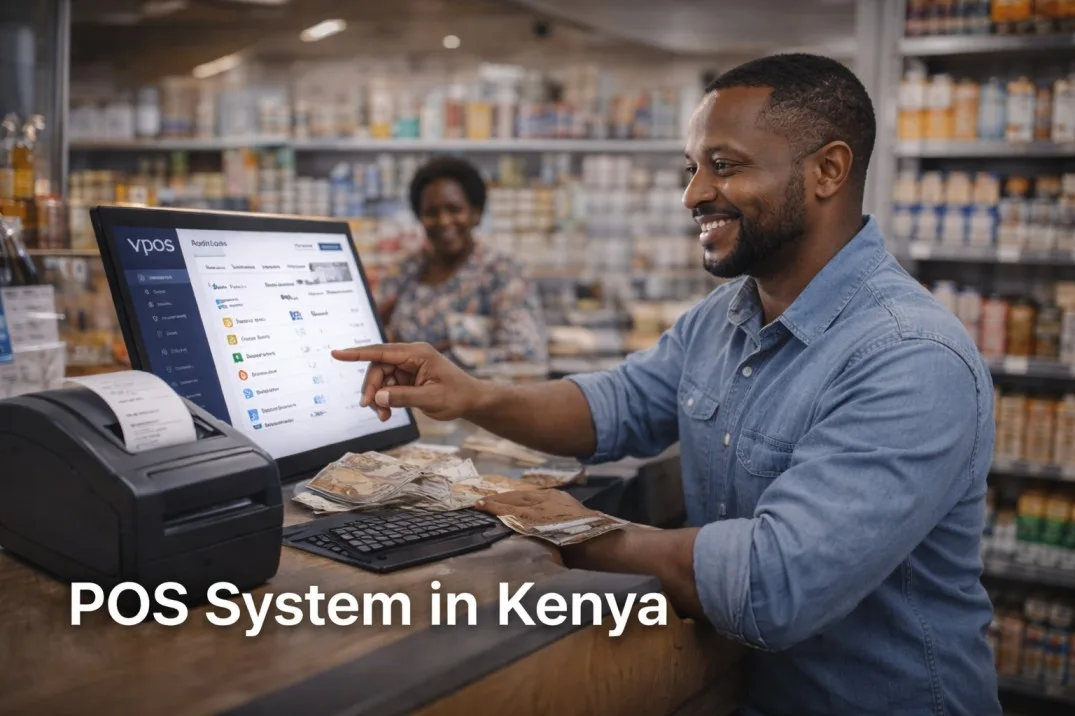
VPOS is designed to help businesses manage sales, products, inventory, users, reporting and branch operations from one system. The scale may be different from a Premier League stadium, but the objective is very similar: process demand efficiently while retaining control of the business.
Explore the VPOS features available to Kenyan businesses.
From football statistics to business analytics
Data is also playing an increasingly visible role before the season has even started.
Sky Sports' pre-season supercomputer model, based on 10,000 simulations incorporating factors such as historical performance, transfer activity and betting odds, currently gives Arsenal the highest probability of winning the 2026/27 title.
That does not mean a computer knows who will win the league. Football remains unpredictable. What the model demonstrates is something businesses should understand: historical information becomes much more valuable when it is analysed rather than merely stored.
AI does not replace good data
One of the biggest misconceptions about artificial intelligence is that simply adding AI automatically makes an organisation smarter.
AI depends on information.
A football analytics system needs reliable match and player data. A retail intelligence system needs reliable sales, stock, customer and product data.
That means the first step towards an AI-enabled business is often much simpler: digitise operations properly.
- Record every sale accurately.
- Track inventory movements.
- Maintain clean product information.
- Control which users perform which actions.
- Generate reliable reports.
- Use the resulting information to make better decisions.
Football technology is becoming a connected ecosystem
Consider what surrounds a modern Premier League match:
- Computer vision assists offside decisions.
- VAR systems support referees.
- Cloud infrastructure supports digital services.
- AI helps supporters explore football information.
- Real-time data improves broadcasts and analysis.
- Digital tickets control stadium entry.
- Cashless payments process matchday purchases.
- POS and inventory systems support retail and hospitality operations.
None of these technologies operates in isolation. Together they create a connected matchday ecosystem.
What should businesses learn from the Premier League?
The lesson is not that every business needs expensive artificial intelligence tomorrow.
The lesson is that technology creates the most value when it solves a specific operational problem.
For a football competition, that might mean faster offside decisions or richer fan statistics. For a Kenyan business, it might mean reducing checkout time, preventing stock-outs, monitoring several branches or knowing daily profit and sales without waiting until the end of the month.
That is the practical philosophy behind VPOS: use technology to make everyday business operations easier to control.
The opening weekend gives us another technology story to watch
Arsenal's Friday-night meeting with Coventry City starts a Matchweek that includes Hull City against Manchester United, Brentford against Tottenham Hotspur, Manchester City against Bournemouth, Newcastle United against Liverpool and Fulham against Chelsea.
For our complete football-focused look at the fixtures, new managers, promoted clubs and early title predictions, read:
Premier League 2026/27 Matchweek 1: Fixtures, Predictions and Fan Guide
From the World Cup to the Premier League
This is not the first time we have looked at the connection between modern football and business technology.
Our earlier feature examined how AI, referee technology and digital commerce featured around the 2026 FIFA World Cup.
Read: How AI, Referee Cameras and POS Technology Powered the 2026 World Cup
Frequently asked questions
When does the 2026/27 Premier League season start?
The opening match is Arsenal against Coventry City on Friday, August 21, 2026, at the Emirates Stadium.
How many matches are played in a Premier League season?
The 2026/27 fixture list contains 380 Premier League matches across the 20 clubs.
Does the Premier League use artificial intelligence?
Yes. Microsoft is the Premier League's Official Cloud and AI Partner, with AI being used in digital fan experiences, data services and other technology initiatives.
Does AI make Premier League offside decisions?
Semi-automated offside technology uses optical tracking and computer vision to automate parts of the process, but VAR officials review the generated result before the decision is confirmed.
What is the new 10-second substitution rule?
From the 2026/27 Laws of the Game, a player being substituted generally has 10 seconds to leave the field once the substitution is indicated. If the time is exceeded, the incoming substitute can be delayed from entering until the first stoppage after one minute of playing time has elapsed.
Does VPOS power Premier League stadiums?
No such claim is being made. The Premier League examples illustrate the importance of digital payments, data and efficient retail technology. VPOS is Kenya POS Systems' point-of-sale platform designed for Kenyan businesses.
Sources and further reading
Written by
Kenya POS Systems Team
POS Implementation and Business Systems Team
The Kenya POS Systems team helps Kenyan businesses evaluate, implement, and use VPOS for sales, stock control, reporting, and multi-branch operations.
Share this article
Continue reading
Related articles
Retail POS
System for Supermarkets in Kenya: Features Every Store Needs
Looking for a POS system for supermarkets in Kenya? Learn the essential features for fast checkout, barcode sales, inventory control, purchasing,...
Retail POS
How AI, Referee Cameras and POS Technology Powered the 2026 World Cup
The 2026 World Cup showed how AI, referee cameras, connected-ball data and fast point-of-sale systems can improve decisions, fan service and busi...
Retail POS
Best POS System for Retail Shops in Kenya
A practical guide to choosing a retail POS system in Kenya, including checkout speed, stock control, M-PESA workflows, eTIMS considerations, repo...
Plan your implementation
Want a recommendation for your business?
Tell us your business type, branch count, product volume, reporting needs, and current workflow. Kenya POS Systems will help you identify an appropriate VPOS setup.